PETER SMITH marks the 100th anniversary of the general strike with the tale of a Glasgow ILPer who claimed to be the first non-miner to join the walkout in Scotland. A lifelong unionist and Labour activist, he was also Peter’s grandfather.
James Johnstone Smith, known in later life as JJ, was born in 1904 in Troon, Ayrshire, the son of a joiner who had teamed up with another tradesman to build a pair of semi-detached houses where the two families lived. Unfortunately, this small enterprise went bust and the houses had to be sold.
 The family was forced to live in a tied house and JJ’s father went to work for a larger building company. When his rheumatoid arthritis worsened he took on a much less well-paid clerical job, meaning JJ had to leave school at 14 to work for the Glasgow and South Western Railway.
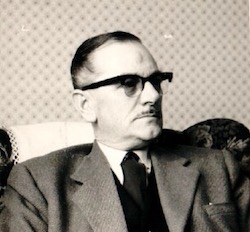
JJ (pictured left) worked his way up to become an inspector, writing timetables, while he was also an activist in the trade union and joined the ILP. He became treasurer of a union branch, although not one where he lived or where he worked because he was wary of being blacklisted.
At work he used to communicate in Morse code over the telegraph wire with a young woman, Sarah Rennie, a clerical worker in a GSWR office in Glasgow. After a few months he asked her out. Her family was a complete contrast, politically – her father, the stationmaster of the goods station in Kilmarnock, was a Unionist party member, a mason and a member of the Orange Lodge.
The couple married, however, and had four children. At mealtimes if they wanted to have a conversation without the children understanding they would pick up a spoon and tap out Morse code on a glass – a skill for life!
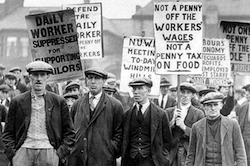
JJ lost his wariness of the blacklist during the 1926 miners’ strike when he was on the Glasgow railway unions’ strike committee, helping organise their walkout in support of the miners. This was timed to start at midnight, so JJ clocked on for his shift at 11.55pm and clocked off again at 11.59pm – thus enabling him to claim he was the first non-miner in Scotland to join the strike.
As he was one of the organisers, the pickets allowed him to escort Sarah (whom he was courting at the time) to work through the picket line as a strike breaker.
Disaffiliation
As we know, the strike was defeated and the railwaymen went back to work. JJ was taken back at his previous grade but lost all his contributions to the railway pension scheme. He had indeed been blacklisted and was told he would never be promoted within the LMS (London Midland and Scottish railway), as it had become known.
 He continued with union activity and became more involved in the ILP. During the disaffiliation debate in 1932 he campaigned vigorously against separating from the Labour Party, arguing it was futile while there was a first past the post electoral system.
The majority of ILP members in Scotland were against the split, but across the UK most members were in favour. JJ spoke at a special conference in Scotland, saying it was “the role of the ILP to convert the Labour Party to socialism”. As we know, the UK-wide conference decided to go ahead.
This caused consternation in the Scottish ILP and in the Labour Party in Scotland. There were disputes about ownership of property and the newspaper, which ended up in court. The ILP won the legal cases on property and there was a compromise over the newspaper, which retained a certain independence from both.
Actual money in bank accounts, cash boxes and so on, was a different matter. A large number of members who had opposed disaffiliation in Scotland formed a group within the ILP called the Scottish Socialist Party. Their aim was to reverse the disaffiliation decision, but in the meantime they enlisted a branch treasurer to move money from sympathetic ILP branches into the SSP and from there to the Labour Party. JJ was the organiser of this secretive process and 40 years later remained very proud that it had had remained completely hidden from history.
For their pains, 2,000 members opposed to disaffiliation (about two-thirds of the Scottish membership) were expelled from the ILP in just three months in 1932. JJ continued as a member of the Labour Party and an active railway union member until, in 1936, he realised there was no prospect of advancement at LMS.
He moved to Birmingham where he joined the Prudential to sell insurance and pensions. His belief that everyone should be entitled to an earnings-related pension became a cause he argued for consistently at Labour Party meetings.
Officer training
During the war the rest of the family moved back to Ayrshire to escape the bombing. JJ joined up in 1942, at the age of 38. When asked by the upper class English recruiting officer where he had been to school he replied “Troon Public School, sir”, which is how it was known. The officer, thinking this was a private school, was impressed and when learning that JJ had written railway timetables immediately sent him for officer training in troop movement control.
Three incidents stand out from his wartime experiences. His only injury was a broken leg caused by a motorcycle despatch rider colliding with his bicycle in the dark of southern England. He recovered in time to go to Normandy seven days after D-day to start organising railway supplies to troops. The second incident was his only experience of hostile fire when the US Air Force accidentally bombed the town in Belgium where he was billeted.
The third also involved the Americans. Rolling stock was in short supply in 1944, so wagons had to be unloaded very quickly and sent back for more food and equipment. One particular US quartermaster was very fussy about grain sacks and refused to take delivery of them. JJ was impatient for the empty wagons and the town mayor was worried about the lack of food for civilians.
JJ proposed the sacks be unloaded and taken wherever the mayor wanted them. This was done and the empty wagons sent back. The mayor was very grateful and gave JJ three fur coats, which my grandmother still wore 30 years later.
In 1945, JJ was offered a promotion to major, but opted to be discharged and returned to Birmingham where he was joined by the rest of the family. He continued to work for the Pru and became treasurer of the trades council, running its famous raffle for a number of years. He was voted out in his late seventies by a group organised by supporters of Militant. He had always been dismissive of ultra-leftists.
JJ also became a magistrate and sat on the bench until mandatory retirement at 70. In the same year (1974) he was made treasurer of the fund set up to help people after the Birmingham pub bombings.
Sarah died in 1984 and, following five years in a care home, JJ died in 1993 just before the birth of his third great-grandchild. All the nurses knew him as JJ and a number of them remembered his work with the city’s trade unions.
My grandfather led a very interesting and politically committed life, one laced with a large dose of pragmatism.
—-
Peter Smith is a member of ILP and active in the co-operative movement.
You can read more ILP profiles here. Many of these men and women – like JJ – were ordinary working people whose extraordinary lives would otherwise be lost to history.