Andy Burnham may not be standing in the Gorton and Denton byelection but his notion of ‘Manchesterism’ has gained much publicity in recent weeks. JONATHAN TIMBERS reviews a new book on the city that casts a critical light on decades of ‘state-led gentrification’ and working class displacement.
The crucial Gorton and Denton byelection is less than two weeks away. The hope of the soft left, Andy Burnham, was blocked from standing by a committee that included prime minister Keir Starmer who, many claim, feared a challenge to his leadership.
 Burnham’s reputation as Labour’s potential saviour largely rests on his time as metro mayor of the Greater Manchester Combined Authority. By achieving strong annual economic growth and taking buses back under public control, he seems to have shown that cities can improve public services and grow businesses.
Burnham himself modestly refuses to take all the credit, instead praising local leaders who preceded him, such as former Manchester City Council leader Richard Leese and its former CEO, Howard Bernstein. He credits these figures with creating ‘Manchesterism’, a form of partnership between the private sector, universities and an interventionist local state that has, arguably, made the city the most dynamic in the UK.
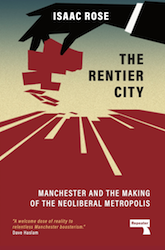
Isaac Rose’s highly readable book, The Rentier City: Manchester and the Making of the Neoliberal Metropolis tells a different story.
Relatively short, it manages to be four books in one. First, it is a history of Manchester, its industry and its radical traditions from the perspective of social geography, with a particular focus on housing. Secondly, it is a cautionary tale of how a radical 1980s local authority was defeated and how it then worked with capital to create a property boom that has transformed the area.
Thirdly, it dissects, usually with forensic accuracy, how the money actually works. And finally, it makes visible the lives and voices of Manchester’s diverse working class, who are being marginalised by the relentless financial logic of Manchesterism.
In the process it disposes of “the legitimising myth” of Anthony Wilson’s role in redeveloping the city. Inspiration for the film, 24 Hour Party People, creator of Factory records and the Hacienda nightclub, Tony Wilson has been credited with starting Manchester’s recovery. It is an exciting fiction in which he ignites Manchester’s turnaround by unleashing the entrepreneurial anarchy of radical popular culture. In fact, Rose shows that Wilson was largely peripheral.
Winners & losers
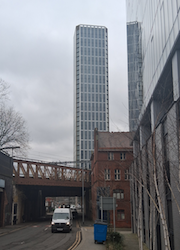
Rose uses a theoretical framework he calls “the two circuits of capitalism”. The first is investment in industrial production, which over time gives way to the second: financialisation through investment in assets, property being the most obvious. (Some of Manchester’s shiny new property is pictured below.)
 Rose quotes the United Nations: “Structural changes in housing and financial markets are global investments, whereby housing is treated as a commodity, a means of accumulating wealth, and often as security for the financial instruments traded and sold on the global market.”
This in essence is rentier capitalism, where markets no longer function, big money always wins and we always lose.
The story of how Manchester became a rentier city starts with Manchester’s Bennite left in the 1980s, which took over the council as a reaction to the local government municipalism of old Labour administrations whose well-intentioned slum clearances often fractured communities and left people feeling powerless.
“Usually it did the right things for people,” Rose writes, “but sometimes it could do the wrong things to people. And only rarely had it previously discussed either of those things with people.”
The rise of the new urban left also reflected Labour’s shift to become a party of urban professionals, lawyers, local government workers, teachers and social workers. It coincided with de-industrialisation and the rise of Thatcherism, which saw radical left local government as a threat to its neoliberal project.
Rose quotes from Doreen Massey, who wrote in 1984 of “the experimentations of a new urban left, a potential socialist response to the crisis of social democracy – a rebuke to ‘the great moving right show’ which could be fought on the left’s terms. The political struggle was live, and the future was not predetermined. ‘Thatcher’s attacks on local authorities were not simply because they are big spenders,’ she wrote, ‘but because they have the potential to show that there is an alternative.’”
This resistance was short-lived as left councils all over the country acquiesced to ‘rate capping’, a measure introduced in 1985 by Thatcher’s government that placed a ceiling on the rates a council could charge. This led to service cuts and staff reductions, and made local authorities increasingly dependent on central government.
As Graham Stringer, then leader of Manchester City Council, put it in 1987 to arch Thatcherite and local government minister Nicholas Ridley, “Okay, you win. We’d like to work together with you.” This is the foundational statement of Manchesterism.
‘Mr Manchester’
The next stage was shaped by ‘Mr Manchester’ – not Tony Wilson but Bob Scott, who mounted Manchester’s bids for the Olympic Games of 1996 and 2000. He developed a type of public private partnership that relied, says Rose, largely on deals done behind closed doors between influential men in business and influential men in local government. He acknowledges that this allowed “an interventionist local government [to carry] over into the entrepreneurial period”.
The Tory’s unelected urban development corporations – created to transform devastated city heartlands – became the model for what happened next. For Rose they were “perforations in the fabric of the welfare state through which a … global new … economics would leak”. In effect, they were “the start of a long assault on the independent powers of local administrations”. Manchester may have developed its own distinctive model but in essence, Rose argues, it was all the same – “private government”.
Then, in 1996 the IRA exploded a huge bomb in Manchester city centre, leaving devastation reminiscent of the Blitz. The new council leader, Richard Leese, and his chief executive, Howard Bernstein, galvanised the city – particularly its business community – to redevelop the centre into “a consumption playground for the wealthy”.
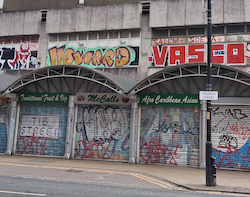 The story of McCalls’ fruit and veg stall exemplifies the process. The McCall family had been running the market stall (pictured left) on Church Street near Afflecks Palace for more than a century. It was hugely popular with Manchester’s Caribbean and African communities and responded to the growth of the city’s educated middle class with an organic vegetable offshoot, a prime example of small scale capitalism working well.
Except it didn’t. The city council granted permission for an abandoned brutalist former post office behind the stalls to be redeveloped into luxury apartments and shops. The stall and all the other quirky little businesses on the market had to go. According to the family stall owner, who I spoke to at the time, the McCalls were not offered an alternative pitch, leaving Black communities to shop elsewhere.
Rose moves the story forward, on to the Blairite regeneration of East Manchester, Ancoats and New Islington, where working class people were left feeling cast adrift. “They’ve ripped the heart out of the community,” said one resident. “Ordinary, working class people, they’re not wanted now.”
Then came the austerity years when a huge rise in homelessness and destitution was visible among the tall new-builds, bars and eateries of central Manchester. This was the time of ‘the Northern Powerhouse’ and drastic council cuts.
The council brought in Chinese capital for property development, a relationship that led to a new brass relief of Engels at Chetham’s School of Music, plus thousands of new apartments that are mostly buy-to-rent or purpose built student accommodation.
Rose focuses on how capitalism extracts value from these developments, including through Manchester Life, a regeneration vehicle that functions through a complex entity involving the council and linked to “a set of Jersey based entities owned by Loom Holdings”.
“In practice … the rental income from apartments … built through a joint vehicle through the council and Abu Dhabi, on public land, is routed offshore, through Jersey and back to Abu Dhabi itself,” he writes. Local government, he argues, is not just facilitating but delivering private development – “state-led gentrification”.
This process of local authorities selling off public land to developers is the greatest privatisation of our time, he says, and Manchester is “a vast extractive machine”. He doesn’t say what else the council should have done with the land, much of which was doubtless acquired for a pittance after de-industrialisation.
Disrupted communities
The impact of all this gentrification on the settled working class communities that ring the city centre, including Moss Side, Harpurhay and Collyhurst, is hugely disruptive. HMOs, AirBnBs and student houses benefit the landlords, in whose interest it is to get rid of longstanding tenants. Displacement can be spatial (they’re forced to move away) or psychological (they feel lost in their transformed and decimated communities). Or both.
Rose’s spiralling narrative leads us towards defeat and misery. He concludes with Walter Benjamin’s commentary on Brecht’s handbook for city dwellers, in which “cities were battlegrounds”. “Today,” says Rose, “it seems only one side is on the offensive.”
All these insights are very useful and the prose is compelling, but Rose’s analysis can occasionally lack nuance, and complicated matters are presented in a one-sided and misleading way.
 He mentions, for instance, the Salboy development in Shudehill – a tall, graceful glass tower that reflects and fades into the sky, a perfect metaphor for ‘liquid modernity’. He rightly lambasts the development’s ‘pocket park’ that turned out to be one cherry tree (pictured left), but then indulges in an ill-informed conspiracy theory about the planning committee while failing to mention how the development has improved Soap Street, which leads to a popular curry house, This and That, where you can still buy three curries and rice for £6.
Rose says the development is emblematic of all that is wrong in Manchester but ducks the fact that the council made the developer fund social housing and replace a derelict brick warehouse with a well designed, sympathetic brick plinth on which the glass tower sits.
He wrongly suggests that party groups on the council use the whip to get planning applications through, while nothing he describes in the planning process was untoward or unusual. He bemoans, “These tussles over planning permissions [that] confine their opposition within strict guardrails: the material considerations that were legally the only ground for refusing applications.”
That’s strictly true – planning committees cannot reject applications due to gentrification. But that’s not the fault of the Labour group whose councillors have tried to extract as much social value from this application as they could. It is fair to say that councillors have limited powers, and the system is weighted against the public interest. But it is not fair to suggest wrongdoing or corruption.
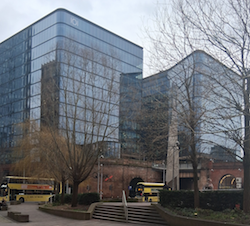 For all its faults, Manchester city centre isn’t just a playground for the wealthy. It is vibrant and still radical. The trendy city dwellers are running their own campaigns against the council, demanding more city centre green spaces (see left). Bev Craig, the new leader of the city council, grew up on a council estate and appears to be prioritising affordable and social housing in new developments.
There are other benefits too. After reading the book, I checked the city’s council tax reduction scheme, which supports those on benefits and low incomes. Its maximum reduction is 85%. In Calderdale, ours is 71%. We had to reduce it last year because of budgetary pressures. Clearly, in Manchester, opening the door to property developers has some benefits and the extraction is not all one way.
Maybe the alliance of the Labour controlled city council with property developers is a Faustian pact, but without it the council would likely be able to do less for its poorest and most vulnerable citizens. This is the tricky moral dilemma Rose overlooks.
Unfortunately, his powerful narrative sucks him down into a helpless negativity and makes him sound, in my view, quite reactionary at times – he dislikes Britpop, for example, and the architectural marvel of Bridgewater Hall, which replaced the Free Trade Hall as home of the world renowned Halle orchestra.
This book made me reflect on that famous phrase by Gramsci: “Pessimism of the intellect, optimism of the will.” The fate of the new urban left may be a political tragedy, but it should not be oversimplified.
As for Andy Burnham and his approach to this complex situation – his 10-year plan for Manchester is worth reading, if nothing else to get an inkling of whether the soft left has any answers to the deep-rooted economic and social problems we all face in our rentier economy.
—-
Jonathan Timbers is a Labour councillor on Calderdale Council in West Yorkshire and a member of its planning committee.
The Rentier City Manchester and the Making of the Neo Liberal Metropolis by Isaac Rose is published by Repeater Books and available here for £14.99.