The left’s response to major conflicts is inconsistent and contradictory, says MJ DENISON. It’s time to learn from history and build a new clear-eyed approach free from binary perspectives.
There are three major ongoing regional conflicts in the world right now – Ukraine (from February 2022), Sudan (from April 2023) and Gaza (from October 2023). Each is a humanitarian catastrophe, yet the response of the UK left to these hostilities has diverged sharply.
In terms of lives disrupted, the civil war in Sudan has had the widest impact. According to UN figures from December 2025, the death toll there is a minimum of 150,000, while 21.2 million people face acute food insecurity, 375,000 live in famine conditions and 14 million have been displaced either internally or to neighbouring states.
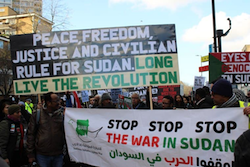 This tragedy has been all but ignored by all strands of the left. There have been no political campaigns of consequence to raise concern about the suffering or press for action by the government, and almost no coverage or debate within the Labour movement. In the UK parliament, only SNP MPs have consistently raised the dispute. Labour, in and out of the chamber, has been virtually silent.
Ukraine is the deadliest war in terms of lives lost. The overall number of deaths is hard to determine but best estimates, based on UN and NGO reports, plus leaked statistics from each government, suggest the likely death toll on both sides is around 250,000, with up to a million people wounded and around 5.7 million Ukrainians displaced.
The left has taken more of an interest in this conflict but its responses differ widely between a small number of Stalinists or ‘Tankies’, a larger number of far left Trotskyite groups and the Stop the War Coalition, and the mainstream Labour left.
The Stalinist groups, found in small sects and sections of the RMT leadership, are inclined to side with Russia, regardless of the Putin regime’s hard-right domestic policies. In this respect their position is closest to those of far right elements within western Europe.
The larger far left groups have tepidly opposed Russia’s invasion but place much more blame on NATO’s expansion to central Europe as the root cause rather than Putin’s aggression. A few Left Labour MPs adopted this line before the conflict started but nearly all retracted their support for Stop the War’s position after the invasion, under threat of having the whip suspended.
Since then, support for Ukraine within the mainstream Labour movement has been quiet and fairly solid. The party seems broadly content to trust uncritically what the leadership is doing, which is to help secure a normative peace rather than a US-engineered realist or transactional resolution.
Otherwise, there is diminished analysis or interest in Ukraine across the UK left. Outside Labour, Ukraine has been consistently backed by nationalist MPs, including Sinn Fein, perhaps with its own eye on the fate of the underdog.
Complete reversal
The death toll of the Gaza conflict from all hostilities since 7 October 2023 – and associated deaths in the West Bank, Israel, Lebanon and neighbouring states, including Yemen – may be as high as 88,000 in total. At one stage the number of people permanently or temporarily displaced, including Palestinians, Lebanese and Israelis living in border areas, reached around five million.
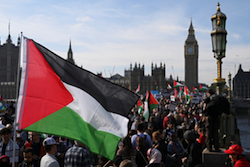 Unlike Sudan and Ukraine, the left has fully mobilised in support of Palestine, with very few voices in Israel’s corner. This consolidates the almost complete reversal of the left’s once solid support for Israel in the 1950s and 1960s. That support was boosted by successive Israeli socialist governments but began to unravel in the mid- to late-1970s, thanks in part to the left’s re-framing of Israel’s formation as a re-colonisation process.
Several prominent Israelis, including progressives, have suggested the left’s singular focus on Gaza and the charge of genocide, rather than on other conflicts, indicates a degree of anti-Semitism or, at the very least, a tendency to hold Israel to a different standard than other states and actors. In this sense, glossing over the atrocities of African warlords, or regarding them as less accountable, could be construed as reflecting a perverse neo-colonialist mindset.
In reality, the truth is more complicated. The UK Labour left’s interest in the plight of Palestinians is relatively long-standing and rooted more in humanitarian concern than in anti-Semitism (although clearly some strands of the latter did creep into Labour under Jeremy Corbyn, as he himself acknowledged). The fact that sections of the left have generally sided with causes opposed to the US, or to the West more generally, may also play a part, although this stance has sometimes produced unsavoury bedfellows, such as in Venezuela and Zimbabwe.
Finally, the particular concern for Palestine felt by sections of the Muslim community has no doubt also contributed to the intense focus on that conflict above others. This was reflected in the 2024 election when some independent candidates were elected (albeit with small majorities on low percentages and in constituencies with very low turnouts), largely because the party leadership was deemed not to have taken a strong enough stand on Israel during 2023/24.
Notwithstanding these factors, there is clearly an inconsistency here if the conflicts are looked at from a simple humanitarian standpoint. The far left’s starting point – essentially supporting causes that stand in opposition to western governments and ignoring others altogether – can be infantile. Trailing uncritically after the Labour leadership’s foreign policy is also insufficient. This is how many in the party rank and file ended up defending the invasion of Iraq more than 20 years ago.
Fresh approach
A fresh approach to foreign policy could draw on lessons from the ILP’s history. Being pro-actively pro-peace is a good starting point. There are a number of armchair generals in western Europe who want to throw more Ukrainian (and Russian men) into the grinder. That is not the morality of socialism nor class-based politics. Robust preventive diplomacy is incredibly hard work. Peace-making and peace-building more so. The interest and commitment to that tradition seems to be virtually absent among the UK left today.
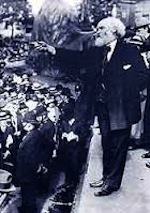 The ILP took a principled stance in opposing ‘the Great War’ in 1914, campaigned against conscription and supported the creation of an international organisation that would settle disputes peacefully. Its critique of the Versailles Treaty was sound. The ILP leaders of the day could not and did not condemn those who chose to fight, but instead emphasised the futility of conflict and the necessity of peace-building. This was the driving force behind Labour figures such as Philip Noel-Baker, who saw first-hand as a non-combatant the despair of the trenches and spent much of his subsequent life advocating for disarmament.
Where the ILP failed in the 1930s was in its naïve assessment of the international situation. Despite warnings from some of those who had personal knowledge of the Soviet system under Stalin, the ILP got its assessment of that regime badly wrong, even after the Nazi-Soviet pact. It was also, like other left organisations, far from clear-eyed about the threat posed by Nazi Germany in the late 1930s. The world is not always as we would like it to be; parts of the UK left have sometimes given the benefit of the doubt to malign actors.
As socialists we have to be clear and rigorous about the international situation and not fall into our comfort zones or adopt binary perspectives. The UK has normative obligations under the systems and institutions of public international law that were painstakingly established in the wake of the Second World War. These were designed to advance the public good and we should respect them.
Labour governments have not always done so. This equivocation was in evidence most recently in Keir Starmer’s reaction to the detention of Venezuelan leader Nicolas Maduro where, to say the least, the US does not appear to have observed due process.
We should not be selective. The Sudanese are people with human rights as well Gazans, Ukrainians and, for that matter, Russians and Israelis. Opposing war does not mean appeasement. It is a recognition that conflict creates a spiral of insecurity and perpetuates injustice.
If the UK left has a contribution to make it can draw on a distinguished history of robust opposition to the proliferation of weapons of mass destruction and the arms trade – especially of small arms that often disseminate from theatres of conflict outwards through criminal groups, as they inevitably will from Ukraine into Europe over the coming years.
A re-commitment to the principles of just and enduring international peace seems somewhat counter-intuitive at this moment of international tension, particularly as the Parliamentary Labour Party’s broader knowledge and interest in foreign affairs and peace work seems negligible. But the left could make a start by pressing the Labour movement to think more seriously about how these principles might be operational in today’s international system.
—-
MJ Denison is a long-standing Labour Party and Prospect member.
See also: ‘WWI: The ILP and the ‘Great’ War’ by Ian Bullock.