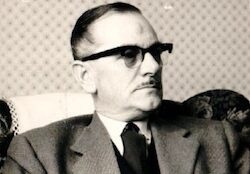
Longtime ILP member and former Labour MP Harry Barnes has died at the age of 89. His parliamentary researcher, GARY KENT, remembers a deeply principled and consequential backbencher who ushered in many initiatives that helped preserve democracy and save lives.
Born in the mining village of Easington, County Durham, Harry Barnes became a longstanding member of the ILP in the 1970s and served as Labour MP for North East Derbyshire from 1987 to 2005. He was self-deprecating but possessed a razor-sharp mind and a sharp tongue when required.
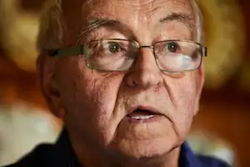 The follicly challenged backbencher once unnerved Tory opposition leader William Hague during the ritual Commons theatre of Prime Minister’s Questions by quipping that Hague gave “slap-heads” a bad name.
He joined the ILP soon after it returned to the Labour Party in 1975, and its independent perspective and approach to politics informed his work on many issues after he entered parliament, most notably on the poll tax and Northern Ireland.
For example, he helped establish broad-based anti-poll tax groups that accepted non-payment wasn’t the answer for everyone who opposed the measure. He also warned that the tax would force many people to simply disappear from electoral registers. Working with electoral administrators, he devised a detailed system of rolling registration that was later adopted by Tony Blair.
The ILP’s thinking on Northern Ireland underlay his long period of engagement with the region and his pioneering work for peace turned him into a respected left voice. Partly thanks to Harry, old left thinking on Northern Ireland was isolated by parliamentary, popular and party work, to which he was central.
In 1990, he and Conservative MP Peter Bottomley founded New Consensus, a cross-party Anglo/Irish peace group that called for an historical enquiry into the Bloody Sunday events of 1972, while he also stood with the relatives of people killed by the IRA in England. He backed the Peace Train when it came to London in 1991, securing the support of bus unions to take participants to the Commons for a special debate he’d organised.
Once, unusually, he alerted Downing Street to a question he was hoping to ask then prime minister John Major at PMQs, so it would get a more considered answer. Unfortunately, Major answered the question before it had been posed.
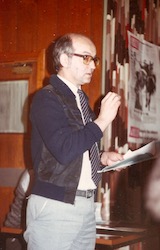 At Labour conference in 1996, he invited Ulster Unionist leader David Trimble to address a New Statesman fringe meeting. That gesture encouraged unionist support for the landmark Belfast Agreement for which he campaigned in referendums in Belfast and Dublin in 1998.
He helped persuade Trimble’s party to join the British-Irish Inter-Parliamentary Body, which gathered senior parliamentarians twice a year and cultivated more co-operative relations after many years of bad blood. He was also an active member of the Northern Ireland Affairs Select Committee and a strong advocate within Labour of allowing party membership in Northern Ireland and for Labour candidates to stand in local and national elections.
This activity didn’t go unnoticed. On a visit to the Maze prison in Northern Ireland, he met the Commanding Officer of the IRA who greeted him with, “Ah, you’re Harry Barnes.”
Later, he picketed Downing Street, where Gerry Adams was meeting Blair, in support of a young Derry man under a death sentence over a minor dispute with IRA members. A brief meeting with Adams in the central lobby of the Commons led to the lifting of the death sentence.
Rebellious ‘bastard’
Harry was known as one of “Blair’s bastards” and came second only to Dennis Skinner in rebellions against the whip, but he always wrote to the Chief Whip to explain his decisions. He was exercising his rights as a backbencher to use his judgement without fear or favour, although that wasn’t always easy.
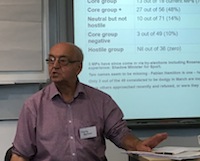 After the Dunblane massacre, for example, the government introduced a sweeping ban on handguns. He argued that it was an over-reaction and suggested an alternative. It briefly made him a hero of gun clubs with which he had no sympathy.
The fate of Iraq was another cause close to his heart, a passion that flowed from his time working on the railways in Basra during national service in the 1950s. The poverty he encountered there inspired his Labour politics.
In 1991, he helped campaigners collect hundreds of tons of provisions to send to two million Kurds sheltering from Iraqi leader Saddam Hussein’s helicopter gunships in the northern mountains. They were dying in large numbers but he convinced Iran to send a 747 plane to supply the Kurds.
He consistently opposed the invasion of Iraq in 2003, then publicly quit the anti-war movement when it callously dismissed the brutal murder by remnants of Saddam’s secret police, of an Iraqi union leader, Hadi Saleh. He’d recently hosted Saleh at a Commons reception.
At the 2004 Labour conference, he played a major role in blocking a motion demanding immediate withdrawal of British troops from Iraq. The international Iraqi union representative said that they hadn’t asked for the invasion but wanted a say about withdrawing foreign troops to avoid a lethal security vacuum.
The North East Derbyshire CLP’s motion was the basis of a policy statement by foreign secretary Jack Straw that urged those with opposing but honourable views of the invasion to unite behind Iraqi unions, of which he was an honorary member.
Harry was also president of Labour Friends of Iraq and in 2006 joined a senior delegation to meet unions from across the country in the capital of the Kurdistan region.
He made weighty contributions to policy thinking on other issues too. In 1991 he and Ken Livingstone penned an article for the Guardian advocating a fully-fledged federal Europe, signalling the end of the left’s support for leaving Europe.
In 1995, he proposed a Civil Rights (Disabled Persons) Bill, using a procedure that could have seen it included on the statute book. It was defeated by the Tories but adopted by the Blair government. He also advocated a Tobin Tax on international financial transactions, which later spawned a broad-based Robin Hood Tax coalition.
Constituency casework was always his priority. Every month, through bumper reports and cuttings, he diligently informed his CLP of meetings and contributions on what he called “the passing trade”.
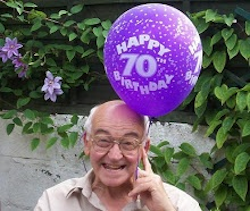 He stood down as an MP in 2005 but never stopped his political work. He soon learned how to use computers and ran a widely regarded blog called Three Score Years and Ten and a regular discussion group at his house in Dronfield.
He remained an active member of the ILP right to the end, often attending and participating in national discussions while contributing numerous knowledgeable articles on a wide range of subjects to the ILP’s publications and website.
In later years, he became increasingly housebound. Suffering from Alzheimers, he died of cancer on 16 February 2026, just months before his 90th birthday.
Harry was a consequential backbencher who ushered in many changes that helped preserve democracy and save lives. He often compared himself to the actor Sam Kydd, who played a vital background character in hundreds of films. He enjoyed the respect and affection of many within the Labour Party, the ILP and across the political spectrum.
He is survived by his wife, Ann, who worked equally long hours as his secretary, and two children, Stephen and Joanne.
—-
Gary Kent was Harry Barnes’ parliamentary researcher from 1987 to 2005.
You can read many of Harry Barnes’ contributions to the ILP here.
26 February 2026
I remember Harry once describing himself as “the most right wing member of the Campaign Group”. I always thought if you wanted to describe the ILP’s politics in one line, that would be it.
25 February 2026
Gary Kent has provided a fitting tribute to Harry Barnes and done him proud. I would like to add a personal reflection. Harry was a dear friend and a highly valued colleague. He was an exceptional Member of Parliament, as well as a dedicated college lecturer, community activist and trade unionist. He was personable in every way.
I will always remember him as a steadfast supporter of the coal mining community and was incredibly generous with his time and advice when I was writing Edith’s Story, the historical biography of my mother’s life.
His loss will be felt deeply by all who knew and worked with him, and most especially by his wife and family. While I do not think I will be able to attend the funeral in person due to my limited mobility, I plan to watch the service online and will certainly support his family’s chosen charity.
During the ceremony, I will be remembering a good man whose contribution to our society was wholly beneficial. He was a true socialist and a dedicated member of the ILP in every way. For those of us who knew and worked with Harry, our lives are richer for that experience.
He will be sadly missed by the many who knew, loved and respected him.