Labour’s performance in the recent Senedd elections has been widely described as calamitous and historic, heralding the end of an era of dominance that stretches back to the birth of the Labour movement. ARUN LEWIS charts the rise and fall of Welsh Labour.
The local election results on 7 May were pleasant for no-one in the Labour movement nor on the broader left in Britain, or indeed Europe. Reform swept the board in many traditionally working class areas across the UK, while also cutting into former Conservative territory in the shires. Meanwhile, neither the Greens nor Labour appear to have solid control of the left-wing lane in British politics.
 For Labour, the story was particularly dire in the devolved nations. Having hoped in 2024 to challenge the SNP for control of Holyrood, Labour was instead relegated to a dismal joint second place with Reform, despite Anas Sarwar’s earlier calls for Keir Starmer to resign as prime minister.
Labour has not won a majority in the Scottish Parliament since 2007, and has barely recovered nationally from 2015 when many of its MPs lost their Westminster seats. Increasingly, the notion of Scotland as a Labour heartland is nothing but a memory, a nostalgic gem of knowledge shared only by veteran activists and Labour historians.
For a long time Welsh Labour had reason to think its plight was different. Plaid Cymru’s emergence in the 1960s as an electoral force did not generate the same threat to Labour as the rise of nationalism in Scotland, in part because of the dominance of the English language and English sentiment in Wales.
But slowly, over the years, a tripartite division began to emerge as Wales split into three regions: ‘English Wales’ close to the border and in pockets of Pembrokeshire and Carmarthenshire; ‘Welsh Wales’ around the Valleys, Cardiff and Newport, encompassing much of the population and the of heart of its economic, political and cultural heft; and the truly Welsh speaking, historically rural areas of the north and west.
Yet, despite the resultant surging force of nationalism in recent years, and the increased prominence given to the Welsh language, Labour remained the dominant political force in the devolved assembly and at Westminster elections. Until now.
That dominance was based on roots that go back a long way. Unlike Scotland, Wales as a distinct legal entity did not exist from 1536, when the Marcher lordships and principalities were amalgamated into the English county system, until devolution in the late 1990s. For a century before then, Wales was a Labour stronghold, returning iconic leaders of the movement such as Keir Hardie and Michael Foot, among many others.
Welsh Labour reached its peak in the 1960s when Harold Wilson appointed the first Secretary of State for Wales. In the 1966 general election, 32 out of the 35 elected MPs were Labour representatives.
Nationalist challenge
But the challenge from the nationalists began to emerge soon afterwards. In 1966, Gwynfor Evans won the 1966 Carmarthern by-election for Plaid Cymru, and subsequent UK elections saw the number of Plaid MPs tick up to between three and five, depending on the national fortunes of Labour at the time. However, Plaid never broke out beyond its nationalist stronghold in western Wales, neither into south Wales nor the more populous areas of the north near the border where the majority of Labour’s Welsh MPs were elected.
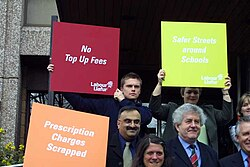 Labour’s hold on Welsh politics continued after devolution in 1998 when it held majorities in the Welsh Assembly under Ron Davies and Alun Michael, both of whom resigned in quick succession. Having lost leadership contests to Davies in 1998 and Michael in 1999, Rhodri Morgan (left) eventually secured the job in 2000, despite opposition from UK Labour’s Blairite leadership.
Morgan was a politician of the party’s broad left and a disciple of Wales’s long left-wing tradition, one that includes figures as diverse as Aneurin Bevan, Arthur Horner, Leo Abse and Neil Kinnock, as well as several non-Welsh MPs elected to Welsh constituencies, such as Hardie and Foot. Unlike Davies and Michael, Morgan was a leader elected without the favour of London, and so not privy to the Blair government’s whims or will.
It was Morgan’s tenure as First Minister that saw Labour secure its devolved rule in Wales, partly through a strategy of putting ‘clear red water’ between his policies and those of the troubled UK leadership during the later Blair and Brown years. While the national party became increasingly centrist and focused on the concerns of middle England, Welsh Labour committed to a more statist, left-wing approach, eschewing the third way politics of Blairism and committing to a more vocally socialist rhetoric.
From 2007-10, Plaid collaborated with Welsh Labour when it fell short of a majority in the Assembly, but the direction of travel remained largely unchanged. Carwyn Jones and Mark Drakeford followed closely in Morgan’s footsteps, keeping to the left of the national party’s enduring centrist tendency, focusing on local delivery, and opposing the various post-2010 Conservative governments at Westminster – a strategy that helped secure majorities for Welsh Labour at successive elections before and after the Assembly became the Senedd, with increased powers, in 2020.
Even at the low points of the 2015 and 2019 UK general elections, the Welsh party was one of the healthiest in the movement, far better than its contemporaries in the north of England or Scotland at maintaining support among a changing electorate, and rivalled in popularity only in those large urban polities such as Manchester, Birmingham, Liverpool and London.
Distinctly separate
One of Welsh Labour’s main assets was that, since devolution, it had stood distinctly separate from the national party and been able to battle with the Tory government at Westminster, which was always generally unpopular in Wales.
 For all Welsh Labour’s internal failings, the increasing professionalisation of rival outfits such as Plaid, and the inevitable public exhaustion that comes from having served so long, plus the emergence of Brexit-based campaigns designed to split Labour’s working class base, Welsh Labour govenments could at least claim to be better at representing Wales’s interests than the Tories in London.
No party really challenged Welsh Labour during these years. It received 30-40% of the vote in every election until this year, while Plaid’s high-water mark remained 17 seats back in the first Assembly election of 1998.
The Conservatives, meanwhile, never stood a realistic chance of having a First Minister, the Liberal Democrats have never been a huge force in the devolved assembly, and while populists such as UKIP momentarily threatened Labour’s grip on power, they could never sustain the challenge.
All that changed in the 2020s, for several reasons.
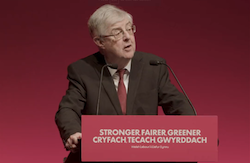
As First Minister, Drakeford (pictured above) led the nation through the pandemic, and like many incumbents during the Covid years, he faced polling struggles as a consequence, not least thanks to policies such as the universal 20mph speed limit, which provoked widespread rage and bitter public backlash.
Once Labour was elected to national government in Westminster in 2024, criticisms of the Welsh party’s record on education and healthcare became louder, and its failings began to outweigh its successes, despite the introduction of free school meals and nationalised rail before the UK government got there.
After Drakeford’s resignation in 2024, Vaughan Gething was elected to take over only for allegations of corruption during his previous ministerial tenure to rapidly sink his leadership. The Gething affair pushed Labour into a polling spiral as the scandal encapsulated all the unwelcome traits that can engulf a party that’s served in office for a long time: incompetence, complacency and arrogance.
With Reform UK now gaining serious ground in the polls and Plaid emerging as a genuine contender for power under new leader Rhun ap Iowerth, the Welsh Labour Party was suddenly under siege.
Gething’s successor, Eluned Morgan, had a distinguished career in European, British and Welsh politics. When she was elected to the European Parliament in 1994, she was the youngest MEP at only 27 years old. She served on the boards of a range of independent, third sector charities as well as in various positions across the Welsh government, plus in Labour’s shadow ministerial team in the House of Lords from 2011-16.
As leader, she did not do anything egregiously wrong. Her attempt to recapture the spirit of Rhodri Morgan with a ‘Red Welsh Way’ was not out of character for a Welsh leader. But by 2024 when she took over, her government was already a victim of inertia as the deep unpopularity of the UK Labour leadership hampered her efforts to govern Wales in a different way.
Morgan also took on the leadership towards the end of the Senedd term when Labour was already unpopular. What’s more, as a parting gift to his party, Drakeford had implemented a regional list electoral system for Senedd elections, ensuring the party’s constituency strength was diluted as contests would now be fought on a larger, regional scale.
Seismic results
The recent seismic results are a consequence of all these shifts. At the 2026 Senedd elections, Plaid won 43 of the 96 seats up for grabs, while Reform took 34 and Welsh Labour fell to nine on 11% of the vote. The Tories also suffered, falling from 14% to 10.7%, while the Greens won their first two Senedd seats.
Labour’s decline has been calamitous and historic. The party has lost 25% of its vote since 2021. Morgan lost her own seat and Labour failed to be the largest party in Wales for the first time in 108 years. The last time Labour failed to secure a majority of the Welsh vote was in 1918 when David Lloyd George, a Welshman himself, triumphed nationally, leading the victorious Liberal-Conservative coalition.
By the next election, when the full, universal franchise for all adults over 21 was bedded in, Labour won most of the votes and most seats, a victory it repeated in every Welsh election from then on … until this year.
As for what happens now, Plaid Cymru is not yet as narrowly myopic on the independence issue as the SNP, and Welsh nationalism encompasses a far greater linguistic component than its Scottish counterpart. Also, Plaid has had governing experience before, in coalition, and in supply and confidence arrangements with Labour administrations.
The two-way collapse of Labour’s vote – progressives breaking for Plaid and the working class abandoning the party for Reform – threatens to consign the proud legacy of Welsh radicalism to the same fate as its Scottish variety, leaving Labour to fight an endless losing battle based on occasional situational advantages and legacy voters.
 The early Independent Labour Party never commanded as large a following in Wales as it did in Scotland and returned fewer MPs of the stature of James Maxton, John Wheatley and Jennie Lee. Partly this was a consequence of the late conversion of many Welsh trade unions from Lib-Labism to outright Labourism, in particular the South Welsh Miners’ Federation. But it was also because the early Labour leaders who emerged from Wales had more mixed legacies, not least one-time ILPer Ramsay Macdonald, for a time MP for Aberavon, who later became synonymous with treachery in the party.
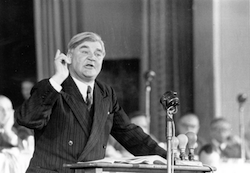
On the other hand, the most famous Welsh politician, Aneurin Bevan (pictured above), was undoubtedly a radical of the left, if not as far left as the ILP and similar left-dissident groups during his time. His powerful oratory was part of a Welsh tradition of public speaking, while his case for socialism, In Place of Fear, was perhaps the most convincing penned by any MP in the 1950s. Bevan held his seat in Ebbw Vale amidst the deep poverty of the interwar years, serving much as Hardie had, as an independently minded ‘minister for unemployment’.
His later achievements as a minister for health and housing – including founding the NHS, building hundreds of thousands of homes after World War Two, and refusing to allow the healthcare budget to be raided for an excessive defence programme – loom large, not just in Welsh and socialist memory, but in British political history.
In Blanaeu Gwent, the Senedd constituency that includes Bevan’s old stomping grounds, Labour came third on 7 May with less than 8,000 votes, way behind Plaid on 29,000 and Reform on 24,000.
No result from last week can sum up the Welsh Labour Party’s demise as well as that. Even in the shadows of its giants, the century-long Welsh socialist project lies in ruin.
—-
Arun Lewis is a history and politics student at the University of Oxford who is writing a thesis on the changing politics of trade unions in the Welsh valleys in the 1910s.
You can read more of his published work here.
See also: ‘Border Country: Beyond Radical Federalism in Wales’ by Alun Burge.