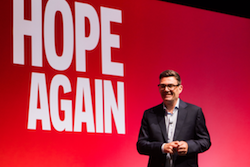
Labour came to power promising unprecedented support for the co-operative sector. Eighteen months on the prospect remains more a taunting hope than the driving force of social and economic change many had wished for. CHRIS OLEWICZ & STEVE THOMPSON chart the progress so far, but fear a genuine grasp of co-operation’s transformative potential is absent from government thinking.
When the Labour Party launched its general election manifesto, Change, in One Angel Place, Manchester, in June 2024, the significance of the venue was clearly apparent to the now prime minister, Keir Starmer. The Co-operative Group, he said, ‘”is [an] organisation that has long believed … that the pursuit of social justice and economic growth must go hand-in-hand.” [1]
 These two commitments, Starmer emphasised, would be at the heart of his strategy for economic growth. Eighteen months later, as the UK loses jobs to artificial intelligence faster than any major economy, those commitments face their sternest test. [2]
What Starmer did not mention was that for more than a century, the Co-operative Group, previously known as the Co-operative Wholesale Society (CWS), served as the heart of something rather more ambitious. The CWS operated factories employing thousands, servicing hundreds of member-owned retail co-operative societies, offering an alternative to capitalism itself – the elimination of “the middleman, the employer, and the private creditor” and their substitution by “the collective ownership and control of the affiliated co-operator.” [3]
To its adherents, co-operation was not simply business or a means of “getting rid of the bosses”. [4] It was a self-help movement committed to removing the barriers between working people and a life led with dignity.
Co-operators shared this vision with the Rochdale Pioneers of 1844, who sought not merely cheaper and unadulterated food, but to advance “their social objectives through concrete economic action.” [5] A store, certainly. But also housing for members, factories for the unemployed, land for those displaced by the enclosures, self-sustaining communities where profit served people. They built the co-operative movement into “a way of life” – “the songs they sang”, the “bread they baked in co-operative bakeries” – the co-operative commonwealth. [6]
The July 2024 election returned a Co-operative and Labour government to parliament with an overwhelming mandate. A record 43 Co-operative Party MPs were elected on a four-point policy platform to double the size of the co-operative and mutuals sector in Britain, promote community owned renewable energy projects, introduce a community right-to-buy for local assets such as social clubs, and strengthen protections for retail workers to promote safer high streets.
Chief executives of the largest mutuals had called for a “meaningful covenant between mutuals and co-operatives, government and society”, demanding a Minister for Mutuals and Co-operatives, a British Business Bank Fund for existing co-operatives, legislative reform, and Post Office mutualisation, arguing that “co-operatives … increase consumer choice … offering a competitive alternative to shareholder-owned businesses.” [7]
Invisible alternative
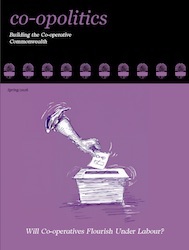
Our new journal, Co-opolitics, has been created to support these policies and critique their implementation – to assess rhetoric against reality in the tradition of those who understood that democratised ownership was necessary, not merely desirable.
AV Alexander, the titan of co-operative politics who served as First Lord of the Admiralty under Churchill and as Secretary of State for Defence in the 1945-49 Labour government, recognised in 1936 that “the political fight of the next few years will largely range around whether collectivism in industry and commerce is to be based upon ownership by, and service to the common people, or is it to be based upon the corporate state, and with an ever-expanding system of incorporated industry for private profit.” [8]
That fight was lost. The corporate state won. Ninety years later, as companies achieve significant productivity gains from artificial intelligence while eliminating rather than creating jobs, we face the same question – but now with housing shortages, vanishing well-paid work, and a population losing faith in the future who may well turn to extremism. [9]
In the coming years, co-operation might well prove to be the mechanism by which a significant number of people in this country rejuvenate and strengthen their communities. Liberal democracy faces pressure from reactionary forces that offer straightforward explanations for the complex problems arising from successive waves of economic, social and technological change.
 The issue is not simply that tasks once taking weeks can now be accomplished in minutes by computer, but that the pool of well-paid jobs will shrink until a significant percentage of the population can no longer maintain a decent standard of living. What happened to the manufacturing sector in the 1970s and 1980s might well be replicated across other sectors. As actor Steve Coogan (left) warned in July 2025, the government’s approach amounts to “putting Band-Aids on the gash in the side of the Titanic” – mitigating the worst excesses of a broken system rather than transforming it. [10]
Yet the alternative that once offered a different path remains largely invisible: as economist and former Green MEP Molly Scott Cato observes, “When I go to my Co-op shop, most of the people shopping there don’t have a clue that something is going on there that’s actually deeply subversive of capitalism.” [11]
We have some grasp of the problems. We express concerns about the decline of the high street. We recognise the deleterious effect that lack of work and opportunity has on our communities. We worry about declining numbers of graduate vacancies. Yet we continue ordering goods and services from online multinational corporations and shopping at for-profit supermarkets.
In the political realm, genuine debate about how we will live and work in the future is sidelined in favour of oppositional politics, with potential solutions kicked into the long grass. The years pass, the difficulties intensify and decline accelerates. The public crave solutions but nothing seems to work.
What might work? As the documentary filmmaker Adam Curtis suggested, “The real key to the politics of the future is going to be a way of somehow allowing people still to feel they are part of something, yet also feel they are individuals who can follow their own desires.” [12]
Culture shock
In Middleton, Greater Manchester – the borough that gave birth to the co-operative movement – a grassroots initiative is attempting to answer that need, but from an unexpected starting point. Middleton Co-operating is not, despite its name, primarily focused on establishing co-operative enterprises. It is teaching people how to co-operate at all.
After decades of Thatcherite individualism and the erosion of social infrastructure, the capacity for collective action has collapsed so completely that communities must rebuild it from scratch. As Steve Coogan, the project’s patron, observes, “They are so used to being disempowered that their mindset takes a while to adjust to the fact they have autonomy. It’s a culture shock.” [13]
Through ‘circles’ using sociocratic decision-making, community events and grassroots relationship building, Middleton Co-operating is doing the pre-movement work: creating trust, demonstrating collective efficacy, shifting mindsets from disempowerment to agency. This is essential work. It takes time. The original co-operative movement required decades of attempts and failures before the Rochdale Pioneers succeeded in 1844.
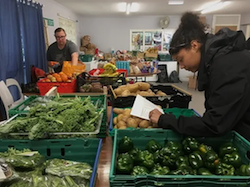 That capacity, once built, enables practical organising. Co-operation Town (left), launched in 2019 in Kentish Town, north London, demonstrates what becomes possible when neighbours work together. Over 50 autonomous food co-ops now operate across the network, with members contributing £3-£6 per week to collectively purchase wholesale food and acquire surplus groceries from businesses.
The savings are substantial – up to 40% off regular food costs – but the model’s significance extends beyond price. As founder Shiri Shalmy emphasises, food co-ops are “based on solidarity, not charity”. Members decide collectively what to buy and how to run their co-op, building the habits of democratic participation whilst meeting immediate material needs. [14]
This is consumer co-operation reimagined: not competing with Tesco’s economies of scale but creating an alternative distribution system through collective purchasing power and food redistribution. It doesn’t create traditional employment, but it keeps money in communities, reduces waste, and demonstrates that collective action delivers tangible results.
The worker co-operative movement, though small, is also organising independently. In 2022, frustrated that Co-operatives UK – representing the entire co-operative economy – struggled to be “a specialist organisation for worker co-ops”, activists established workers.coop as “a new and independent federation of worker co-operatives, co-operators and supporters of industrial democracy.” [15]
The federation’s manifesto sets out a vision of a society where “workers aren’t exploited”, “wealth is spread fairly”, people have “personal and collective control over their working lives”, and “capital serves workers, not the other way round”. [16] With only around 400 worker co-ops in the UK compared to thousands in Spain, Italy and Argentina, the movement remains marginal – yet growing.
By early 2023, workers.coop had 48 enterprise members and had raised more than £120,000 to support peer learning, campaigning and specialist development advice. The challenge, as organiser John Atherton observes, is reaching “beyond existing worker co-ops” to make worker control and collective ownership “accessible and relevant to new groups and generations of workers”. [17]
In February 2024, Jim McMahon, then the Co-operative Party’s parliamentary chair, argued that, “It’s not co-operative business ventures versus other business, what the co-operatives want is to be able to operate on a level playing field.” [18] As lead minister on the English Devolution and Community Empowerment Bill, McMahon has since delivered a community right to buy, giving communities power to acquire threatened local assets.
Yet his framing – co-operatives seeking “a level playing field” with multinational corporations – understates the challenge. The fix isn’t competing more fairly within the existing system; it’s building an alternative economy. As planning expert Victoria Yeandle warns, legal rights alone achieve little. A genuine transfer of power, she argues, “requires funding, capacity building and technical support”. [19] These are real achievements after decades of neglect. The call for evidence is gathering views to inform future policy – a necessary first step.
Thick ecosystem
At the Co-operative Party’s annual conference in November 2025, ministers outlined some of the other concrete measures. Peter Kyle, Secretary of State for Business, announced that the British Business Bank would have funds specifically to develop co-operatives and support co-operative entrepreneurs. Steve Reed, Secretary of State for Housing, detailed the Pride in Place Programme: £20 million over 10 years for 150 impoverished locations, supported by a new Co-operative Development Unit. Miatta Fahnbulleh, Under Secretary of State for Housing, Communities and Local Government, described the Development Unit as “a powerful resource” to enable communities to take ownership of spaces and places. [20]
 Alex Norris, Minister for Democracy and Local Growth, framed the stakes clearly: “This is the battle for the soul of communities. Reform are pretending they care, but we have been doing this for a century… We want to say: ‘Here’s the agency.’ Joe Fortune, Co-operative Party General Secretary, hopes the government leaves office having “radically shifted the balance of power and ownership”. [21]
These announcements represent genuine progress. The question is whether they constitute the “thick ecosystem of institutions and cultures that provide the information, advice, expertise and support necessary for co-operatives to grow” that Co-operatives UK identified as essential back in 2019. [22] Will there be investment in mass co-operative education, networks of trained community organisers, infrastructure for the cultural reconstruction that the Middleton group shows is vital?
The government’s focus remains on worker co-operatives and enterprise –production rather than consumption. An alternative economy requires both: worker ownership of production and consumer support through purchasing choices. Neither can succeed without the other.
Consider home care. Why should elderly people pay premiums to shareholders for basic dignity? Why should care workers endure poor conditions in return for a substandard service? Care workers could organise co-operatively.
In Ireland, the Great Care Co-op demonstrates the model’s viability: clients and families report consistently high-quality, reliable care, whilst care workers experience secure employment and professional fulfilment. Research shows that the co-operative’s worker-ownership model fundamentally shapes care delivery, prioritising client needs over profit extraction. [23] In the UK, Equal Care Co-op in West Yorkshire’s Calder Valley gives control to both care recipients and care workers through a platform-based model that prioritises relationships over rotas, delivering people-centred care that is more holistic and meaningful. [24]
As artificial intelligence eliminates administrative and logistics roles, care work remains inherently human and relationship-based. Yet under shareholder ownership, productivity gains from technology flow upward whilst care workers’ wages stagnate. Co-operative ownership would ensure workers benefit from any efficiencies while maintaining the dignity of care.
The same logic applies to community energy: why should bill-payers fund dividends for distant utility shareholders when co-operative ownership could keep profits local, reduce costs and accelerate the transition to renewable generation? Or childcare: why should parents pay extractive fees to private equity-backed chains when co-operative nurseries could employ qualified staff, charge sustainable fees, and give parents a voice in provision?
Worker, consumer and community ownership models exist for each. These obstacles are not insurmountable. They need time, resources and education – all solvable with political will.
Public wreckage
Labour inherited the wreckage of 14 years of ideologically motivated austerity. Public institutions have been stripped for parts and local authority budgets slashed. The NHS staggers between crises, ill health spreads, and economic inactivity rises. Utilities extract dividends rather than serve the public. It now faces unavoidable decisions about ownership and control, pressured by competing global models: US hostility to collective action, Chinese state capitalism, and European regulated markets.
 This context makes the fundamental question urgent: what are co-operatives for in 21st century Britain? The answer should be clear: they are the mechanism through which communities retain wealth, workers share in productivity gains, and people maintain agency in an economy increasingly dominated by extraction. Yet this requires not just legal frameworks but a mass movement capable of building thousands of co-operatives, educating millions of people, and shifting everyday consumer choices away from extractive corporations. That movement barely exists.
Yet these measures pale against the scale of investment flowing elsewhere. As Daniela Gabor warned in The Guardian, Labour has chosen a different path for the bulk of its economic strategy: “It will get BlackRock to rebuild Britain.” [25] The approach follows a familiar formula where cash-strapped government partnerships with private finance transform public infrastructure into profit streams for distant investors.
Housing, education, health, nature and green energy are all being repositioned as assets that must generate returns for shareholders. Under this model, housing is treated as capital not a basic need, education becomes a revenue generator, health care serves shareholder dividends, and even nature and green energy are redesigned as vehicles for financial extraction.
Recent reports that Private Finance Initiatives (PFI) will be revived in order to pay for the new generation of community health centres is worrying. [26] Of course, this is the easy option. It is easier for the government to show it has improved conditions quickly by going for the PFI money. It is also easier to sell politically when the first response to any policy is, “How are you going to afford it?”
Two competing approaches to economic development are playing out against a challenging political backdrop. Thirty-four per cent of those who describe themselves as highly cynical about politics now back Reform compared to just 9% supporting Labour. Keir Starmer’s “island of strangers” speech was a grave error.
Steve Coogan’s warning in July 2025 that Labour’s “managed decline” approach was paving the way for Reform UK has proven prescient. [27] Without addressing the root cause – poverty and economic decline in post-industrial areas – Reform’s support will continue to grow. There’s a reason why Farage launched his campaign in a working men’s club.
In this context, it is the Co-operative Party’s focus on bringing communities together which is increasingly being seen as a solution. These communities are where the next few years of British politics is going to be decided. [28] Of course, with Reform recruiting increasing numbers of Thatcherites to its ranks, it is unlikely they will have any ideological temperament for co-operatives or public investment.
The stakes for getting the balance right could not be higher. Will Heathrow’s third runway improve life in Blackpool? Will increasing bankers’ bonuses create jobs in Rochdale? Will private equity investment reduce bills in Workington? Unlikely, and if so, marginally. But co-operation might.
Adult social care co-operatives where workers own the service they provide and clients receive consistent, relationship-based care. Taxi co-operatives where drivers own the platform and keep their earnings. Community energy schemes that keep profits local. Housing co-operatives offering security and mutual support. Childcare co-operatives where parents and workers share control.
Missing movement
For nearly 200 years, co-operatives have offered Britain an alternative to both concentrated private ownership and state control. They democratise markets, ensuring equal access rather than concentrated power. The missing ingredient is not legislation. The government has begun to provide that. The missing ingredient is a movement.
This requires, not just infrastructure and policy, but the hard cultural work of teaching people that alternatives exist, that collective action is possible, that workers can own their care agencies, that communities can trust each other enough to build something together – slowly, patiently growing a pool of capital, just like any corporation.
Real transformation requires the government to use its considerable power: procurement policies that create guaranteed markets for co-operative social care, childcare and energy; substantial investment in the co-operative development infrastructure; educational reform that makes co-operative ownership a normal part of business education. The gap between what has been announced and what would be necessary suggests the government sees co-operatives as a supplement to the existing economy rather than an alternative to it.
Government can remove barriers. It cannot create movements. Only people can do that. The question is whether enough people will choose to build the co-operative economy before the window closes – with their daily choices, their time, their commitment.
If technology continues to eliminate work while only shareholders benefit from productivity, and the workers who create that productivity see wages stagnate and jobs disappear – then we face a stark choice: mass destitution, or a fundamental rethinking of how we organise ownership and distribute the gains from progress.
Co-operatives could offer a path towards a fairer, more democratic, less alienated future – if we act now. There’s no time to waste.
—-
Chris Olewicz & Steve Thompson are directors of Principle 5: Yorkshire Co-operative Resource Centre based in Sheffield.
This article this is an edited version of their editorial for the first issue of Co-opolitics, a new journal from Principle 5 promoting the political and ideological practice of co-operation.
Principle 5 have launched a crowdfunding campaign to raise funds for the journal. You can contribute here.
Notes
[1] Keir Starmer Launches Change – Labour’s General Election Manifesto, 13 June 2024.
[2] Lauren Almeida, ‘AI is hitting UK harder than other big economies, study finds’, The Guardian, 26 January 2026.
[3] GS Watkins, Co-operation: A Study in Constructive Economic Reform (University of Illinois, 1921), p6.
[4] Alana Semuels, ‘Getting Rid of Bosses’, The Atlantic, 8 July 2015.
[5] Brett Fairbairn, The Meaning of Rochdale: The Rochdale Pioneers and the Co-operative Principles (University of Saskatchewan, 1994) p7.
[6] Peter Gurney, Co-operative Culture and the Politics of Consumption in England, 1870-1930 (Manchester University Press) p4,23.
[7] Rebecca Harvey, ‘Co-op and mutual leaders call for political support as UK election looms’, Co-operative News, 12 June 2024.
[8] ‘The Monopoly Menace’, Sheffield Co-operator, No.142, October 1936, p1.
[9] Lauren Almeida, ‘AI is hitting UK harder than other big economies, study finds’, The Guardian, 26 January 2026.
[10] Josh Halliday, ‘Steve Coogan accuses Labour of paving way for Reform UK’, The Guardian, 5 July 2025.
[11] James Hawksworth, ‘Molly Scott Cato: Green Party is a good match for co-op movement’, Co-operative News, 7 January 2026.
[12] ‘Adam Curtis on the fall of the Soviet Union’s worrying parallels with modern Britain’, PoliticsJoe, 19 October 2022.
[13] Rebecca Harvey, ‘Steve Coogan on why he is backing the Middleton Co-operating project’, Co-operative News, 8 July 2025.
[14] Tom Duggins, ‘Can food co-ops really cut grocery bills by 40%? I set one up with neighbours to find out’, The Guardian, 31 May 2025.
[15] Rebecca Harvey, ‘New federation planned for worker co-ops in the UK’, Co-operative News, 1 June 2022.
[16] workers.coop, ‘About us’.
[17] Miles Hadfield, ‘Looking back on the first year of the UK’s worker co-op body’, Co-operative News, 2 May 2023.
[18] Zoe Crowther, ‘Lesser-Known Co-op Party Could Shape A “Key Pillar” Of Labour’s Economic Plans’, CityAM, 4 February 2024.
[19] Victoria Yeandle, ‘The English Devolution and Community Empowerment Bill’s Right to Buy’, Planning Resource, 22 December 2025.
[20] Notes from Co-operative Party Annual Conference, 19 November 2025.
[21] Catherine Neilan, ‘Why the Co-operative party is Labour’s best shot at stopping Reform’s rise’, The Observer, 5 July 2025.
[22] ‘A National Co-operative Development Agency’, Co-operatives UK, September 2019.
[23] Gerard Doyle, ‘How worker co-ops could provide effective and sustainable elder care in Ireland’, RTÉ Brainstorm, 6 November 2025.
[24] ‘Equal Care Co-op: An innovative approach to social care’, Co-operatives UK, 15 January 2024.
[25] Daniela Gabor, ‘Labour is putting its plans for Britain in the hands of private finance’, The Guardian, 2 July 2024.
[26] Heather Stewart, ‘“Past mistakes must be avoided”: anxiety as Labour eyes public-private funding for NHS’, The Guardian, 20 August 2025.
[27] Josh Halliday, ‘Steve Coogan accuses Labour of paving way for Reform UK’, The Guardian, 5 July 2025.
[28] Catherine Neilan, ‘Why the Co-operative party is Labour’s best shot at stopping Reform’s rise’, The Observer, 5 July 2025.