JOHN CUNNISON recalls a long-forgotten chapter of working class struggle in Stoke-on-Trent that local activists and historians are bringing back to life.
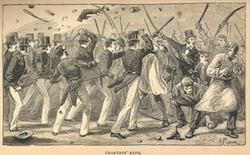
Every August, in the heart of North Staffordshire, a small but determined collection of activists, trade unionists and local historians gather to remember an event that has been largely erased from public memory. The Potteries Peterloo, as it is known locally, happened on 16 August 1842 when a group of striking miners and local Chartists were brutally suppressed by government troops and local militia.
 The protest – held exactly 23 years after the infamous Peterloo massacre near Manchester – began as a peaceful gathering of local people demanding the right to vote and parliamentary reform. It ended in the so-called Burslem riots with soldiers opening fire, leaving one man dead and dozens injured.
Despite the horrific violence, this chapter of working class resistance has remained hidden for decades, even in the very city where it took place, and is absent from most labour history books.
Four years ago, the People’s History Association of North Staffordshire (PHANS) decided to put that right, staging the first of what has become an annual festival to commemorate the events of that fateful day and explore the broader legacy of Chartism – an often overlooked movement that laid the foundations for modern trade unionism, cooperative societies and the labour movement itself.
At a time when political disillusionment is again widespread, and many feel left behind, the story of the Potteries Peterloo is a reminder of how far we’ve come – and how much further we still have to go.
On that August morning in 1842, miners and Chartists from across Stoke-on-Trent marched to Burslem – the area’s “mother town” – demanding fair representation and an end to the oppressive conditions of industrial Britain.
The Chartist movement had already gained traction in the region, especially among its working poor, thanks to the six demands set out in the People’s Charter of 1838: a vote for every man over 21; secret ballots; no land, wealth or property requirement for MPs; payment for MPs; equal electoral districts; and annual parliamentary elections.
The authorities, however, were not prepared to listen. When protesters refused to disperse, the Riot Act was read and government troops – backed by a locally raised militia – opened fire. Josiah Heapy, a local man, was shot and killed, and many others were seriously injured, while 146 protesters went to prison, 54 of them later shipped to Australia, a punishment so severe it was usually reserved for the most violent criminals.
Collective power
Such harsh repression did not crush the movement, however; it galvanised it. Chartism in Stoke evolved and the cooperative movement emerged from its ashes, growing strongly over the decades. By 1932, the Burslem and District Industrial Co-operative Society boasted 50,000 members and 112 shops – a testament to the power and attraction of collective action.
 Sadly, things are rather different today – only a handful of generic Co-op stores remain, their radical origins long forgotten. This erasure of collective memory is precisely why PHANS exists: to reclaim and celebrate local working class history before it disappears.
Chartism is widely remembered as one of the earliest movements for political reform and universal male suffrage. But it was always more than that. Most active from the late 1830s to the late 1850s, it should also be remembered as the first organised working class movement in history. Although many of its leaders came from more wealthy backgrounds, its base was firmly rooted in the struggles of miners, potters and factory workers.
The transition from feudalism to capitalism in the early 19th century had created new forms of exploitation and Chartism was the first major challenge to powerful owners, and the Tory, Whig and, later, Liberal parties that dominated British politics. Out of its ferment came socialism, anarchism and cooperatism – ideologies that would shape the next two centuries of radical political thought.
The ILP and the Labour Party owe their existence, in part, to the groundwork laid by the Chartist movement and the trade unions that followed. It is largely thanks to those later movements that five of the six original Chartist demands have long since been met.
Chartists believed society would be transformed by their reforms. And in many ways, it was. Yet, despite such progress, the UK today is still, to some extent, a semi-feudal society masquerading as a liberal democracy.
Parallels with the 1840s are striking. Now, as then, people feel disenfranchised. Political engagement is at an all-time low, while the consequences of poor governance are inescapable. Austerity has left us with a desperate housing crisis, wage stagnation, growing poverty and widening inequality. Many voters feel their voices do not matter. And the political consequences are frighteningly evident in the rise of Reform UK and the return of far right agitators to our streets.
Accessible politics
The question now is, how do we re-engage a public that seems to have lost faith in democratic politics?
History offers some answers. The Clarion movement, a late 19th century socialist organisation, did not just preach politics – it entertained and educated. Clarion vans toured the country spreading socialist ideas. But they also organised cycling clubs, choirs and cultural events, making politics accessible and enjoyable.
 This tradition of education through engagement lives on in today’s working class festivals. The Potteries Chartist Festival is just one of many similar events that have sprung up across the UK in recent decades. Others include the Wigan Diggers’ Festival (which is 14 years old) and the Women Chainmakers’ Festival in Cradley Heath (held since 2005).
These have joined a handful of more long-standing events such as the Tolpuddle Martyrs’ Festival (going for more than 90 years in Dorset); the Derby Silk Mill Festival (held intermittently since 1834) and the Durham Miners’ Gala, the grandest of them all, celebrating mining communities and working-class solidarity since 1871.
These events do more than remember; they revitalise. They remind communities of their power, their history, and their capacity for change.
PHANS was founded by local trade unionists and Labour activists who recognised that Stoke-on-Trent’s working class history had been deliberately airbrushed from public consciousness. Once a bastion of organised labour – with coal mines, steelworks and pottery factories – the city was devastated by Thatcher’s deindustrialisation programme and the impact of offshoring. As union membership declined, so did the memory of collective resistance.
At its peak, Stoke was a Labour stronghold, with the party holding every council and parliamentary seat in the region. But as industries collapsed, so did political engagement. By the 2020s, the Conservatives had taken control of the council and Labour was reduced to opposition until a resurgence in 2023/24 when the party regained some ground.
Contested history
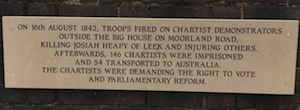
It was against this backdrop that PHANS was born. Its first achievement in 2018 was to erect a plaque commemorating Josiah Heapy’s death. But a plaque was never going to be enough, so they decided to organise an event, both to mark the past and to bring it to life.
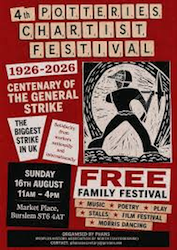
 Since its inception in 2023, the festival has grown into a vibrant, educational and unapologetically political gathering. Each year, there is a secondary theme. In 2024 it was the 1984/85 miners’ strike; in 2025, the 100th anniversary of Arthur Berry, a local playwright and poet; and this year it was the 1926 General Strike.
Next year’s event is already being planned and the theme will be the reconstruction of Lidice, a Czech village razed by the Nazis and rebuilt with donations from Staffordshire miners.
As well as speeches (there are plenty of those), the festival features Morris dancing, poetry readings (including performances by former Potteries laureate Nick Degg), and live music from acts such as Joe Solo and Banner Theatre. Every performance is designed to engage, educate and inspire.
At first, the PHANS event went largely unnoticed, but this year a reactionary voice emerged in the local press, dismissing the Chartists as a “mob” and downplaying their political significance. A counter article, rebutting the smear, was published rapidly in response.
History is always contested, of course, and those in power have a vested interest in suppressing narratives of resistance. As the old saying goes: “First they ignore you, then they laugh at you, then they fight you…”
At least the festival is no longer being ignored. Indeed, it’s fighting back. History matters because it is never just about the past; it’s also about the future.
The Chartists were dismissed as radicals in their time, yet five of their six demands became law. The miners, the suffragettes, the trade unionists – all were once told their causes were unrealistic, dangerous or unnecessary. Yet, without their struggles, we would not have the rights, protections and freedoms we take for granted today.
Stoke-on-Trent is often held up as a symbol of “left-behind Britain” – a city that’s suffered from deindustrialisation, austerity and political neglect. But it is also a city with a hidden tradition of struggle.
Marking the events of the Potteries Peterloo is not just about remembering Josiah Heapy or the Chartist movement; it is about reigniting that spirit of defiance. In an age when political apathy is rampant and many feel powerless, it offers a reminder that change is possible if we organise, educate and inspire.
The past is not dead. It is waiting to be rediscovered. And in Stoke, at least, a small but dedicated group is ensuring that it is.
—-
John Cunnison is chair of the area activists’ committee of Unite the Union and a member of Unite’s national Labour Party Liaison Committee.
More about the Potteries Chartist Festival is here.