Understanding anti-Reform voters could be key to blocking Nigel Farage’s electoral route to Number 10 according to a new report from the anti-extremist campaign group, Hope not Hate.
Blocking the Path found that a higher proportion of the British public would be unhappy with a Reform UK government (43%) than would be pleased to see Farage as prime minister (36%). But this group is far from coherent, ranging in political outlook from ‘agitated activists’ and ‘hopeful left’ voters to ‘comfortable moderates’ and ‘disaffected right-wingers’.
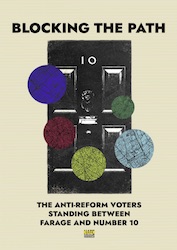 Based on a survey of more than 8,000 anti-Reform voters, the report found that they fall into five very distinct categories, from people firmly on the left to people who agree with Reform on some issues but can’t stand Farage.
“That matters more than it might sound,” says the report’s author, Anki Deo. These voters are significantly willing to vote tactically to keep Reform out, so need to be targeted with specific, tailored messages and tactics to maximum anti-Reform voting in those constituencies where a split opposition could allow the far-right party to claim victory.
“Our MRP poll finds that Reform is competitive in 463 seats, and in 199 of them a split opposition vote could be its main route to victory,” says Deo. “Understanding these voters could be the key to closing that gap.
“Blocking the Path looks at where Reform UK is really a threat, what’s driving opposition to them, and which factors could shape the next election.”
The report concludes that: “For tactical voting to work at the next general election, voters need clear information about which party is best placed to beat Reform in their seat. They also need to feel there is a genuine national risk of Reform forming a government, and that the tactical challenger is distinct enough from Reform to justify voting outside their usual preference.”
Electoral threat
It also says that focusing exclusively on immigration in anti-Reform campaigning may not be the most effective strategy.
“Although immigration and asylum is Reform’s flagship policy area, anti-Reform voters are most concerned by the prospect of Farage as prime minister, the impact on the NHS and social care, and the consequences for the cost of living and the economy,” it says.
“Many anti-Reform voters also hold anti-immigration views themselves — meaning Farage’s unpopularity and the risks Reform poses to the economy and household budgets may be more persuasive than immigration framing alone.”
Despite Reform’s current difficulties over party funding and dodgy donations, the electoral threat it poses remains as real and frightening as ever.
“With the party and leadership struggling, Reform victory is far from inevitable,” says the report. “Yet complacency is not an option, with so many seats unprecedentedly close to call. By looking at a target audience that expands beyond the usual sub-groups of ‘progressives’ or ‘moveable middle’ we can see the full electoral picture.
“The work to begin now is not selecting the one issue or one party that can reach anti-Reform voters – that will come much closer to an election date. Rather, we should be exploring how different angles of the ecosystem can play their part in building anti-Reform disapproval, and converting this into productive electoral dissent.”
—-
Blocking the Path: The Anti-Reform Voters Standing Between Farage and Number 10 can be downloaded here.
More about Hope not Hate’s campaign against Reform UK is here.