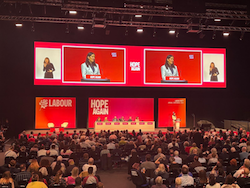
Hope was in the air and on the walls at Labour’s recent conference in Liverpool. JOHN CUNNISON sat through every speech. Here’s a delegate’s view of an event that may (or may not) become a landmark in Labour history.
In September 2025, I attended Labour Party conference for the first time as a delegate, representing my CLP. This year I returned as a delegate with Unite. The contrast was sharp: my union duties included a daily morning meeting to align positions, and during the day there was little scope to leave the hall – the block vote means each delegate potentially carries thousands of votes, so absence for a division can decide a result.
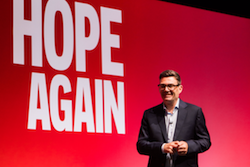 But that wasn’t the only difference.
The conference in 2025 felt corporate and synthetic – stage-managed applause, standing ovations every five minutes, a bubble atmosphere, far-right protesters outside, little genuine optimism. This year, proceedings were still managed and on message, but the applause was genuine and there was a real sense of hope in the hall. Outside, the far right had been replaced by Defend Our Juries. Plus ça change? Perhaps.
Because I had to be present throughout, I sat through literally every speech. Some were good; too many felt formulaic. My test for a speech: close your eyes – could it plausibly come from a Tory or a Liberal? Last year, they all failed.
This year, although a number seemed derivative, rather lacking in substance and full of backslapping, there were some really positive announcements that generated a different energy. Yes, a lot of speeches felt like run-of-the-mill New Labour fare with a Burnham makeover, but the response was warm and authentic.
Ed Miliband, for example, was very much in his element on stage. He introduced the Norwegian prime minister, Jonas Gahr Støre, to a warm reception and later delighted conference with his “you were right” comments to pro-Palestine activists, before reasserting support for the two state solution.
Clearly Labour’s foreign policy is now moving in a more ethical direction, although Miliband is still constrained by the need to keep the PLP on side. Robin Cook Mark II isn’t likely any time soon.
Chancellor John Healey delivered the first set-piece speech of the event, and what a difference from the distant, robotic delivery of Rachel Reeves. He announced a renewed industrial strategy (“our coal mines are not coming back”) with £6 billion investment in contracts for British shipyards, including a £115 million marine research vessel and UK-built floating docks at Faslane.
He heavily hinted at a welfare strategy combining overall cuts with offers of jobs to young people in place of benefits, calling it “a moral duty”, sweetened by a local apprenticeships service and £15 million for a revived union learning fund. “Fiscal discipline”, he said would frame the 28 October budget (abundant 1990s-style funding is “simply not there now”), while he pledged that British workers would not to be left behind in the dash to AI. There was no mention of wealth taxes or of abandoning fiscal constraints, but it still marked a significant shift.
Angela Rayner delivered her customary barnstorming address, rattling through references to the Renters’ Rights Act; to councils given 60 days to bid on social homes that come on market; a ban on housing associations turning away homeless families without valid reason; new protections for five million leaseholders via an independent regulator and compulsory licensing of managing agents; caps on fees and ground rents; a cladding remediation acceleration plan; and a new decent homes standard with binding obligations on repair times.
This was all evidence of tangible action from a Labour government of a sort that we just wouldn’t have heard 12 months earlier.
Epoch defining
We wouldn’t have heard anything like Andy Burnham’s speech a year ago, either. The main event was highly anticipated everywhere, just as much inside the conference bubble as outside among the watching media and Labour-supporting public.
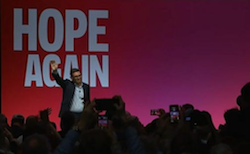 On the day itself, the atmosphere was amazing. Queues formed early, everybody wanted to be there when he started, and once he did start you knew why. It felt genuinely epoch-defining – finally, a true Labour leader’s speech.
When he talked about his childhood and his family’s struggles he came across as believable. Speaking without a script, he had the audience hanging on every word. The emotion was palpable; an “I was there” moment.
He started by calling out those underlying structures of our society that too many Labour leaders have failed to name – neoliberalism and austerity. That in itself gave Labour members hope. The word itself was plastered around the hall and featured in every speech, but he could say it as many times as he wanted and we would still have lapped it up.
He called out privatisation, over-centralisation and Brexit in a way no recent Labour leader has dared. If we are to fight the far right we have to be honest about the root causes of our country’s ills. No more managerial tweaking, he seemed to say, the elephants have to be named and taken on.
The major policy announcements came thick and fast too: a national care service; “rebuilding our common wealth”; “restoring the public housing stock to what it once”; a water industry bill repealing Thatcher’s ban on public ownership of water companies, starting “a 10-year journey to a very different water system”. He promised that in 10 years, our bills would be “in line with our neighbours”.
But he is an astute politician, and a pragmatic one, perhaps, so he balanced pandering to the left with words of comfort to the right. He mentioned patriotism at the beginning, and later expanded that notion into a defence of the union. He presented it as a positive, progressive vision, talking of his determination not to be “the last Prime Minister of the United Kingdom” but the first to “rewire it to make it work for all people and places”.
This, you sense, will be a theme of future attacks on Plaid Cymru and the SNP – both, so far, have failed to devolve power within their nations. Rather less comfortably for the left, he also talked about controlling and reducing immigration, potentially problematic when growth and skilled workers are both so desperately needed.
According to one fringe meeting speaker, many social democratic leaders in Europe are now looking to the UK and Burnham to provide a way out of the morass left by the collapse of neoliberalism. If nothing else, this speech was a good start.
Factional hands
In between the showcase speeches delegates debated many more prosaic party matters, such as rule changes (on Sunday) and CLP and union motions.
 A noticeable change from 2025 was that the rule changes were genuinely useful and uncontentious. Unlike last year’s rollback of party democracy, we had sensible improvements, such as socialist societies being able to fill vacated NEC places via by-election, Labour Students being allowed to attend conference, and a rule to permit hybrid in-person and online party meetings.
Before attending conference I had failed to grasp how central two internal bodies are: the Conference Arrangements Committee (CAC) and the National Policy Forum (NPF). The CAC decides everything at conference – the priorities ballot, the agenda, which motions are “in order”, compositing, appeals – powers that shape conference outcomes more than all the constituency Labour parties put together.
The NPF was established in 1997 to enable rolling policy debate throughout the year, away from the glare of annual conference – a good idea in theory but only if the NPF is politically diverse. Reading this year’s report, frankly, I doubt it.
In fact, both bodies remain in factional hands. The party leadership is theoretically constrained by conference and NPF policy yet can ignore it when convenient. Starmer ignored a conference votes on arms sales to Israel, for example, while introducing identity cards and plans to restrict jury trials. So far, the Starmerite apparatus persists even under Burnham: the CAC was elected from Starmer’s preferred pool, and Labour to Win will dominate the NPF for two more years, at least.
In the end, no motion went to a card vote; all were overwhelmingly carried. The NPF report was deliberately wide-ranging and vague, so many CLP motions were ruled out as already covered. The composited motion on buses – to “continue to deliver better, affordable, reliable buses”, backing Burnham’s “country for everyone, everywhere” – was so lacking in detail and commitment the Liberal Democrats could have written it. It took a Unite speaker’s demand for bus renationalisation to give it any bite. Indeed, the only serious, regular motions came from the unions.
The one allowable emergency resolution did have have some meat on it – condemning Glasgow city council’s threat of fire and rehire to solve unequal pay by reducing all staff members’ wages. It’s a move that clearly exposes the SNP’s bogus left-wing credentials and implicates the Greens for propping up the minority administration.
Throughout the conference there were points of order handled by the CAC. Two stood out: the Women’s Conference lost one of its two entitled motions when one was composited into a CLP resolution; and foreign policy went undebated – surprising, given the precarious situations in Gaza, Iran and Ukraine.
After a full day in the main hall, there is always the fringe, for those who can summon the energy. I made it to five events.
Possibly the most important was a Campaign for Labour Party Democracy meeting. Some may wonder why this group is still needed in a ‘democratic’ socialist party. Two conferences have shown me. A Cuba Solidarity Campaign event promoted an early day motion, now signed by 101 MPs, condemning a Trump executive order that’s led to a so-called “hidden Gaza” in Cuba.
I also attended a meeting jointly organised by the Labour Movement for Europe and the Party of European Socialists, which was upbeat about rejoining the EU but honest about the hurdles – that the UK would lose all its opt-outs and may have to adopt the euro and join Schengen.
The most positive, for me, was a packed Socialist Campaign Group rally, memorably closed with a rousing speech from Ian Lavery.
As usual, the conference finished with The Red Flag and Jerusalem. This was a far better, more hopeful event than in 2025, although much of it remains stage-managed and contained. As a member of Unite’s National Labour Party Liaison Committee, I am guaranteed to be there next year. After a year of difficult choices, starting perhaps with Healey’s first budget next week, the Labour mood next time could be very different.
—-
John Cunnison is chair of the area activists’ committee of Unite the Union and a member of Unite’s national Labour Party Liaison Committee.
See also: ‘Andy Burnham & the Return of Hope’ by John Cunnison.