July marks 90 years since the start of the Spanish Civil War, a brutal three-year conflict in which British working class volunteers played a valuable part. DAVID CONNOLLY reviews historian Chris Hall’s latest account of ‘the passionate cause’.
At 7.15am on the morning of 11 July 1936 a de Havilland Dragon Rapide plane left Croydon airport and set off for the Canary Islands. It was piloted by Major Hugh Pollard and Cecil Bebb, two fascist sympathisers with British intelligence connections.
 To give the impression of this being a holiday, they were accompanied by Pollard’s daughter, Diana, and her friend, Dorothy Watson. They reached Las Palmas on 14 July and two days later flew General Francisco Franco out to join the Army of Africa in Spanish Morocco. From there he launched an invasion of the mainland and started the Spanish Civil War.
A brutal and relentless fight between Republican forces supporting a democratically elected Popular Front government and its fascist/nationalist right-wing opponents, the war lasted three years, claimed half a million lives and foreshadowed a greater conflict to come.
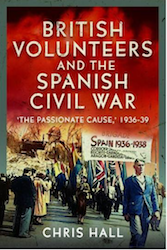
Mainly organised by the international Communist movement and led by the French Communist, Andre Marty, the International Brigades attracted 40,000 volunteers from 52 countries to fight for the Republican government. Chris Hall’s new book – British Volunteers and the Spanish Civil War: The Passionate Cause – is a detailed account of the experiences of 2,500 volunteers from the United Kingdom, 500 of whom died in battle.
As Dave Goodman from Middlesbrough said: “Everybody could play a part in fighting back against fascism; you did not have to be a military man. I was willing and eager to volunteer as long as it was felt I had something to contribute.”
Most British volunteers arrived in Spain having crossed the Pyrennes on foot, a 3,150-metre climb taking 15 hours. They were predominantly working class, a third aged between 21 and 25, and a fifth over 35, while between 60% and 80% were members of the Communist Party of Great Britain.
Their main weapon was the Soviet-made Mosin-Nagant M1891 which had a range of 500 metres. Their bravery in the face of the enemy was second to none.
Heatwaves & freezing winters
An initial group of 150 volunteers helped in the successful defence of Madrid in late 1936 but by February 1937 there were 500 Britons in Spain with their own leadership and training base.
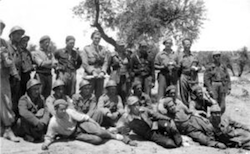 The first major battle they engaged in was at Jarama on 12-14 February 1937 involving a battalion (pictured left) led by Tom Wintringham, who later was a key figure in persuading the British government to establish the Home Guard. Fighting against elite Moroccan troops, the loses were severe with more than 400 British causalities on the first day alone.
This was followed by the Battle of Brunete on 6-25 July, which took place in a Spanish heatwave, with temperatures reaching 38 degrees and without any proper water supply. Six hundred volunteers started the conflict. By 11 July they were down to 208 and by 25 July there were just 42 men left in the ranks.
Although half of these were Spanish, the British battalion grew to 400 by September when they engaged in the Battle of Belchite, which entailed fierce fighting at close quarters over six days. At this point the International Brigades were incorporated into the Republican army.
British volunteers also took part in the crucial Battle of Teruel, a Republican counter-offensive in the mountains of Aragon lasting from December 1937 until February 1938, a period spanning the coldest Spanish winter in living memory when temperatures fell to minus 20.
In total there were 140,000 casualties in Teruel with Republican forces suffering twice the losses of the nationalists. Eventual defeat in Teruel opened the way for Franco to split the Republican territory in two, a strategic blow that led to a massive drop in Republican morale.
The British volunteers’ final engagement was at Ebro on 24/25 July 1938 but by now the war was effectively lost. The remaining volunteers took part in a farewell parade in Barcelona on 28 October when they were feted by Republican politician Dolores ‘Pasionaria’ Ibarruri with the famous words: “You are history, you are legend.”
Chris Hall’s book, which includes a chapter on the 100 or more ILPers who fought in Spain, is a valuable contribution to the extensive literature on the war and deserves to be widely read.
—-
David Connolly is chair of Independent Labour Publications.
Chis Hall’s British Volunteers and the Spanish Civil War: ‘The Passionate Cause, 1936-39 is published by Pen & Sword Books and available for £23.99.
The book will be launched at the People’s History Museum in Manchester on Saturday 11 July when the International Brigades Memorial Trust are holding a one-day event to mark the 90th anniversary of the war.
See also: ‘The ILP, POUM and the May Days of the Spanish Civil War’ by David Connolly, an article based on Chris Hall’s Not Just Orwell: The Independent Labour Party Volunteers and the Spanish Civil War.
And: ‘Bob Smillie: A Moving Tribute to a Brave Man’ by Mariado H